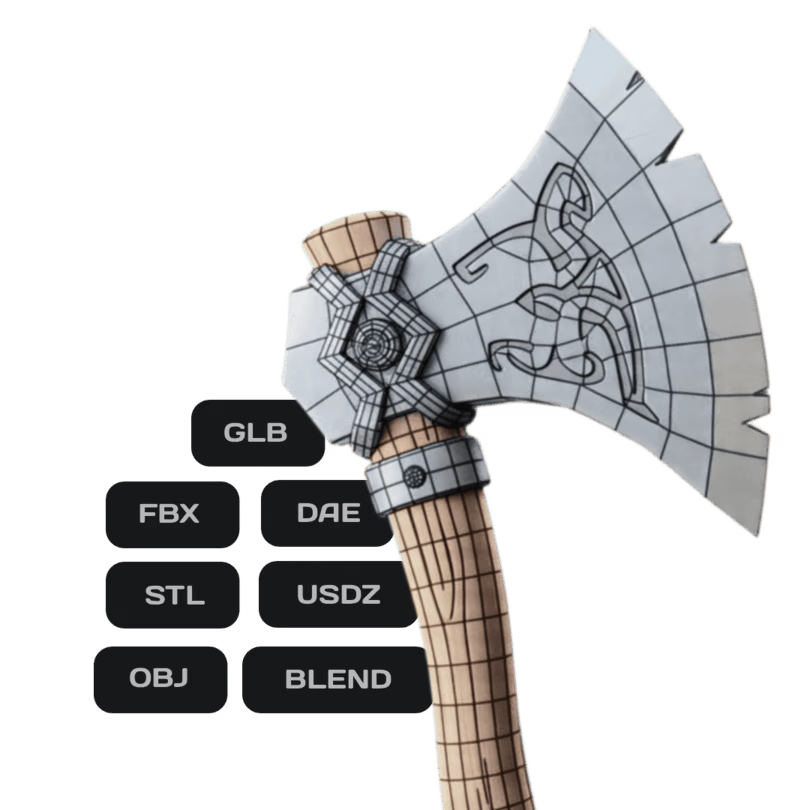
Generate 3D Models with Seed3D 2.0

Upload reference images, describe your vision, and let Seed3D 2.0 create high-fidelity 3D models with PBR materials. Generate physics-ready meshes with a true PBR pipeline and 6K texture maps.

Click to upload image

Required • Supported: JPEG, PNG, JPG

Each time you generate a 3D model, you need to spend 8 Credits.

Your generated 3D model will appear here

02 — OVERVIEW

Seed3D 2.0Technical overview

Geometry, unified PBR (MMDiT · MoE), and scene-scale articulation—summarized for builders. Confirm scope on ByteDance Seed.

Seed3D 2.0 targets sharper meshes, coherent PBR, and simulator-friendly layouts. Each row pairs copy with the same diagram vocabulary as the public release: DiT, VAE, MMDiT, MoE, VLM, and PBR.

Coarse-to-fine mesh generation

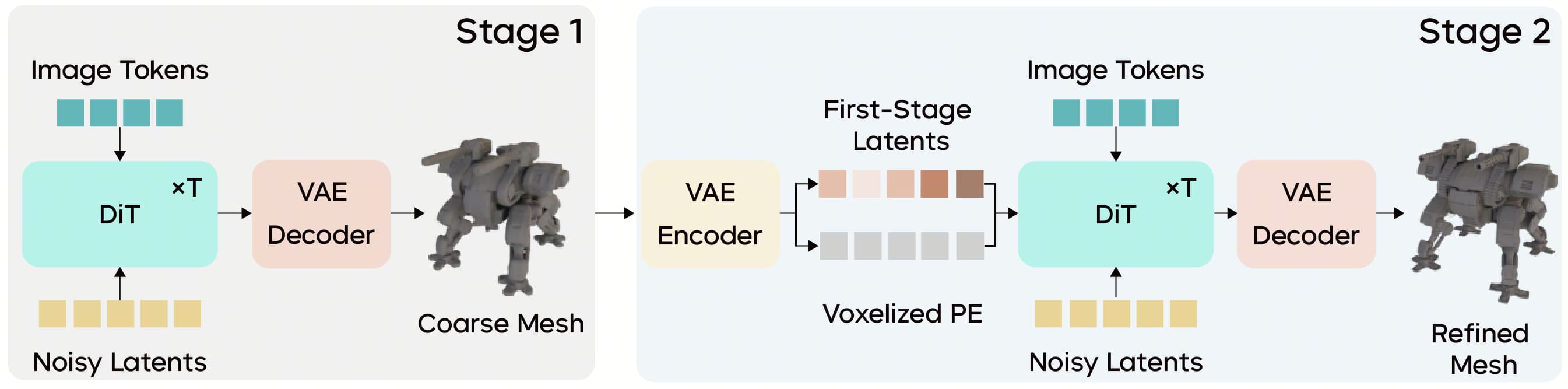
Seed3D 2.0 decouples global structure from surface detail. A first-stage DiT plus VAE decoder forms a coarse mesh you can reason about; a second stage re-encodes geometry, adds voxelized positional encodings and first-stage latents, and runs another DiT plus decoder pass so sharp edges, thin walls, and complex topology read cleanly in the final mesh.

  • Two-stage DiT + VAE loop instead of a single pass that must guess detail and topology at once
  • Voxelized PE and stage-one latents anchor local refinement while image tokens stay in the loop
  • Built for assets that must survive close inspection in DCCs, games, and simulation—not only turntable renders
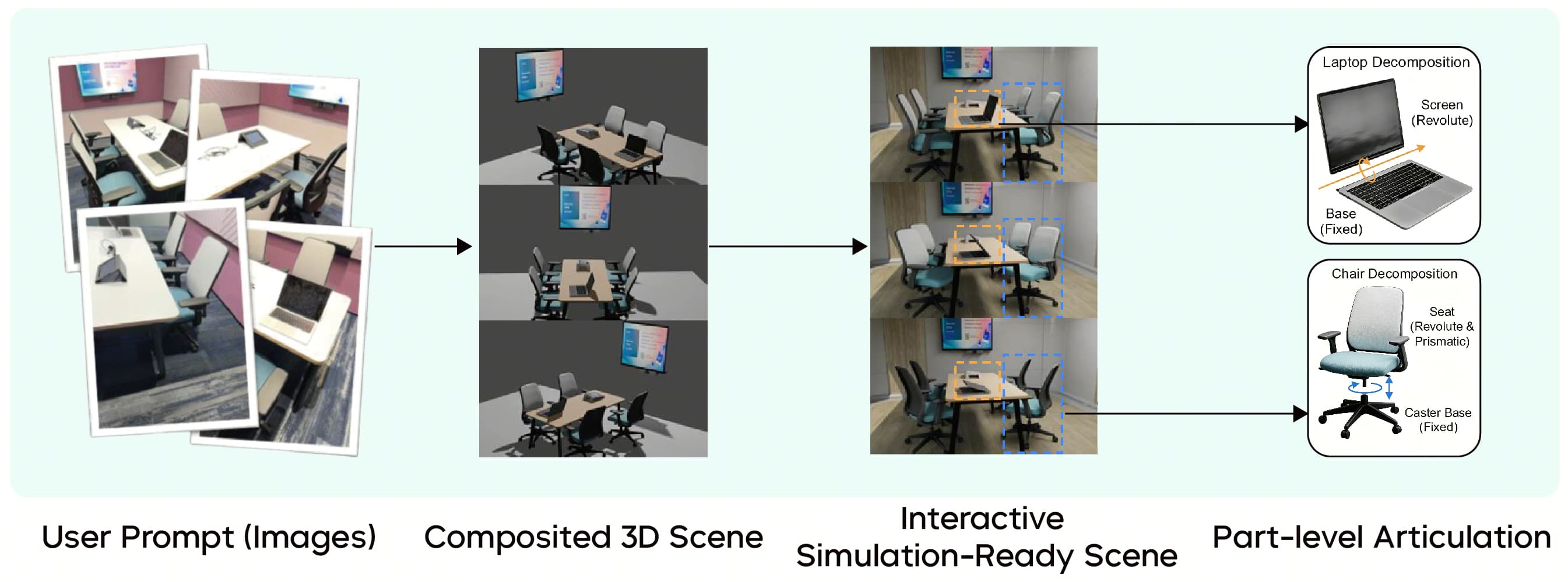
Diagram of the Seed3D 2.0 geometry pipeline: image tokens and noisy latents through DiT and VAE decoder to a coarse mesh, then VAE encoder with voxelized positional encoding and second DiT pass to a refined high-detail mesh.
Reference diagram — Geometry pipeline. Terms and availability follow ByteDance Seed.

Unified PBR with MMDiT (MoE)

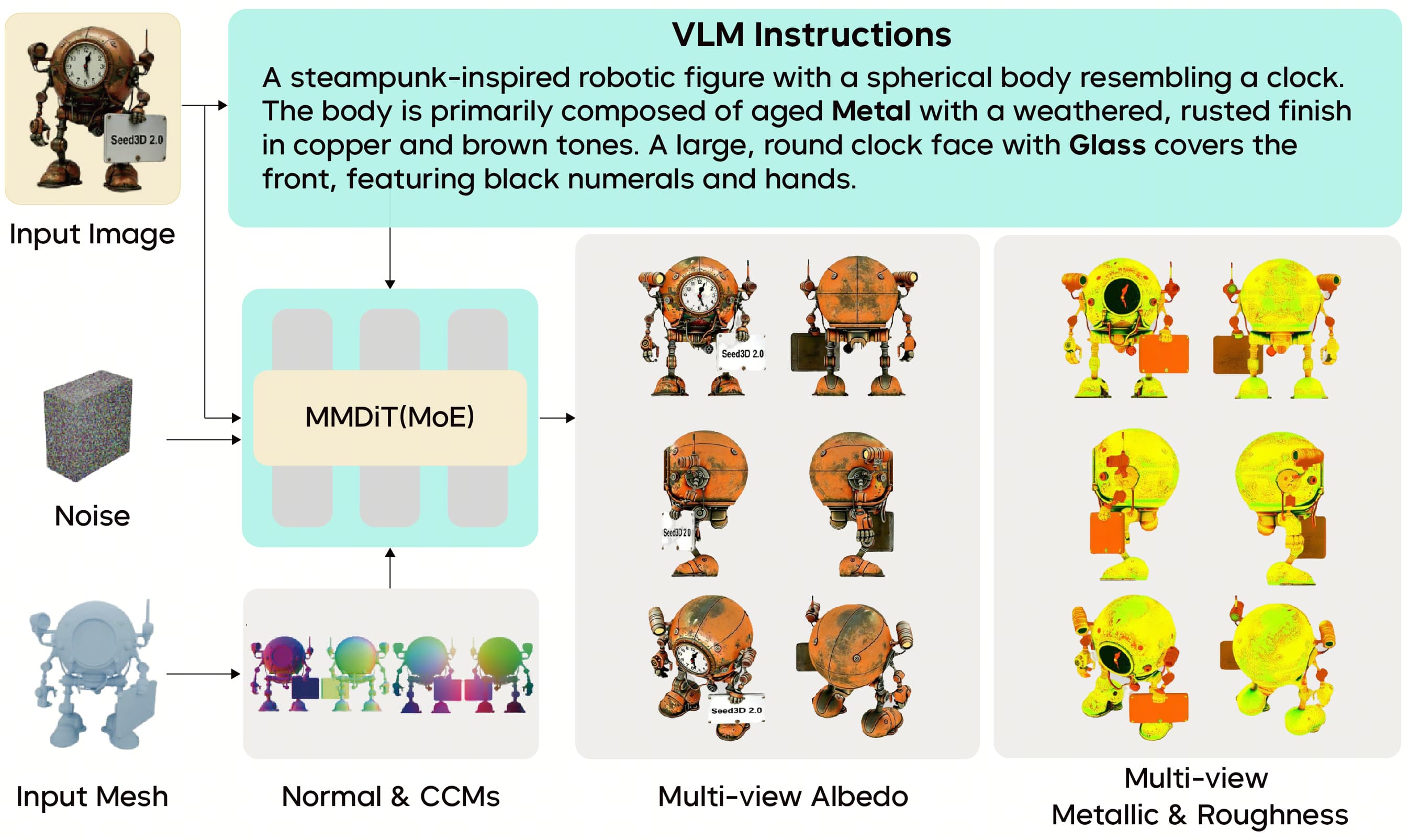
Public materials describe one unified PBR generative path: an MMDiT block with mixture-of-experts routing handles high-resolution detail within budget, while vision-language priors summarize materials in words engineers recognize—metal, glass, wear—so albedo, metallic, and roughness stay aligned across views.

  • Mesh-conditioned normals and CCMs steer the diffusion instead of painting color first and fixing materials later
  • MoE scales expert capacity where the asset is hardest without blowing inference cost everywhere
  • Multi-view map sets are aimed at engines that expect consistent PBR stacks, not single-angle tricks
Diagram of the Seed3D 2.0 texture pipeline: input image, noise, mesh with normal and CCM maps, VLM material instructions, central MMDiT MoE block, and multi-view albedo plus metallic and roughness map outputs.
Reference diagram — Texture & PBR. Terms and availability follow ByteDance Seed.

Simulation-ready scenes and parts

Beyond single objects, Seed3D 2.0 is positioned for layout: photos or prompts become composited spaces, then interactive layers where objects are isolated for simulation, and finally part-level articulation—revolute hinges, prismatic seat travel, fixed bases—so downstream rigs match how props move in the real world.

  • Office-scale composition from multi-image prompts with clear hand-off to “what is manipulable” in-scene
  • Bounding and grouping semantics that match how teams ship environments into Omniverse-class stacks
  • Articulation callouts (revolute, prismatic, fixed) aimed at URDF-style consumers and embodied-AI workflows
Diagram of simulatable scene generation: user reference images to composited 3D room, interactive simulation-ready layout with highlighted objects, and part-level articulation for laptop hinge and office chair motion.
Reference diagram — Scene & articulation. Terms and availability follow ByteDance Seed.

02 — SEED3D 2.0

Key FeaturesSeed3D 2.0

Part-level assets, articulated rigs with URDF-style metadata, and scene-scale layout—aligned with the public Seed3D 2.0 story. Confirm scope on ByteDance Seed.

Part-level generation

Decompose assets for real pipelines

Interactive products and simulation stacks rarely want a single fused mesh—they need parts you can select, swap, and rig independently. Seed3D 2.0 pushes modeling flexibility so assemblies split and merge cleanly: manipulable modules for UX and games, articulated segments for kinematic rigs, and cleaner hand-offs to downstream tooling.

Articulated generation

Joints, axes, and URDF-ready exports

Building on part understanding, Seed3D 2.0 adds articulated modeling that blends multimodal perception with generative geometry. Vision-language models propose kinematic structure and joint types—revolute hinges versus fixed bodies—while geometric priors anchor joint axes. An image-to-video branch can propose motion ranges so limits stay believable, with packaged outputs that include joint metadata in standard formats such as URDF for Isaac Sim-class simulators.

Scene composition

From single objects to full layouts

The same single-object quality extends to scenes. For text, a fine-tuned LLM handles spatial reasoning and layout; for multi-view images or video, depth cues, instance segmentation, and occlusion-aware inpainting help infer how objects sit in space. Once a layout exists, Seed3D 2.0 generates content per instance and assembles it by spatial relationships so you ship a coherent environment, not a pile of disconnected props.

04 — SEED3D 2.0

WhereSeed3D 2.0 fits

Illustrative scenarios aligned with the public Seed3D 2.0 release—local gallery assets below; always confirm product scope on the official hub.

Embodied AI & robotics

Seed3D 2.0 emphasizes articulated assets, URDF-style rigging, and scene composition for simulator-first workflows.

Embodied AI & robotics — sample 1
Embodied AI & robotics
Embodied AI & robotics — sample 2
Embodied AI & robotics
Embodied AI & robotics — sample 3
Embodied AI & robotics

Games & realtime 3D

Sharper coarse-to-fine geometry and coherent PBR maps help teams move from concept art to engine-ready props faster.

Games & realtime 3D — sample 1
Games & realtime 3D
Games & realtime 3D — sample 2
Games & realtime 3D
Games & realtime 3D — sample 3
Games & realtime 3D

XR & visualization

Higher material fidelity and layout-aware scene assembly support immersive experiences built from sparse inputs.

XR & visualization — sample 1
XR & visualization
XR & visualization — sample 2
XR & visualization
XR & visualization — sample 3
XR & visualization

05 — SEED3D 2.0

How to exploreSeed3D 2.0

A practical path: read the official release, open the hub, try the on-site 1.0 generator, then wire exports into your pipeline.

01

Read the release

Start with the ByteDance Seed announcement for architecture, benchmarks, and evaluation framing for Seed3D 2.0.

02

Open the hub

Use the official Seed3D 2.0 hub for product entry, roadmap context, and published access paths (e.g., Volcano Engine) as they appear.

03

Try Seed3D 1.0 here

This site currently ships the Seed3D 1.0-style image-to-3D experience—useful for hands-on mesh and PBR expectations while 2.0 rolls out.

04

Integrate in your stack

Plan exports (USD/GLTF/FBX, URDF where applicable) against your DCC, engine, or simulator; validate licensing and quotas on official channels.

06 — SEED3D 2.0

Human preferenceModel evaluations

Blind pairwise ratings from experienced 3D practitioners—shape-only and textured pipelines—summarized below.

Shape generation
Hunyuan3D-2.5
Hunyuan3D-3.1
Tripo 3.0
Rodin Gen2 v1.9
HiTem v2.0
Seed3D 1.0
End-to-end textured asset generation
Hunyuan3D-2.5
Hunyuan3D-3.1
Tripo 3.0
Rodin Gen2 v1.9
HiTem v2.0
Seed3D 1.0
InferiorSameBetter (Seed3D 2.0)

Bars encode three outcomes in each comparison: raters who judged Seed3D 2.0 worse, tied, or better. Teal shows the share favoring Seed3D 2.0.

On shape generation, Seed3D 2.0 leads every baseline in the chart, with the largest margins against prior-generation systems—consistent with the coarse-to-fine geometry design described in the public release.

On textured, end-to-end outputs, Seed3D 2.0 again wins every listed head-to-head, with human preference above 69% against each mainstream competitor—suggesting gains extend beyond mesh alone into materials and overall asset appeal.

07 — SEED3D 2.0

What teams say aboutSeed3D on seed-3d.com

Quotes below reference the on-site Seed3D AI experience (1.0-class tooling). Seed3D 2.0 availability follows ByteDance Seed’s official hub.

We needed hero products in GLTF for a pitch deck — Seed3D AI gave us clean meshes, believable PBR, and labels that stayed aligned on curved surfaces. What used to be a week of modeling turned into an afternoon.

Marcus T.

Marcus T.

Freelance Commercial Videographer

For rapid creative testing we need meshes that survive close-ups and relighting. Seed3D AI’s roughness and normal detail hold up in renders where other generators fall apart — that’s what we optimize ads around.

Daniel M.

Daniel M.

Performance Creative Lead

Our EU and US teams share one Seed3D AI workflow — same export presets, same material naming. Localization is still copy and VO, but the 3D layer stops being the thing that drifts between markets.

Luca P.

Luca P.

Global Content Ops

We needed hero products in GLTF for a pitch deck — Seed3D AI gave us clean meshes, believable PBR, and labels that stayed aligned on curved surfaces. What used to be a week of modeling turned into an afternoon.

Marcus T.

Marcus T.

Freelance Commercial Videographer

For rapid creative testing we need meshes that survive close-ups and relighting. Seed3D AI’s roughness and normal detail hold up in renders where other generators fall apart — that’s what we optimize ads around.

Daniel M.

Daniel M.

Performance Creative Lead

Our EU and US teams share one Seed3D AI workflow — same export presets, same material naming. Localization is still copy and VO, but the 3D layer stops being the thing that drifts between markets.

Luca P.

Luca P.

Global Content Ops

I storyboard SaaS launches with real geometry now. Seed3D AI turns reference stills into USD-friendly assets we can hand to motion — edges stay crisp and UVs are sane enough that nobody fights the file.

Priya S.

Priya S.

Video Content Strategist

Ecommerce needs consistent scale and believable materials. Seed3D AI outputs PBR maps we can push to 4K+ stills; thin parts like handles and rims don’t collapse the way we saw with other generators.

Nina K.

Nina K.

Ecommerce Content Manager

I used to buy stock 3D kits that never matched the thumbnail. Seed3D AI builds from our own references, so intros and chapter art feel on-brand — and we can iterate the mesh the same day a trend hits.

Sarah J.

Sarah J.

YouTube Strategist

I storyboard SaaS launches with real geometry now. Seed3D AI turns reference stills into USD-friendly assets we can hand to motion — edges stay crisp and UVs are sane enough that nobody fights the file.

Priya S.

Priya S.

Video Content Strategist

Ecommerce needs consistent scale and believable materials. Seed3D AI outputs PBR maps we can push to 4K+ stills; thin parts like handles and rims don’t collapse the way we saw with other generators.

Nina K.

Nina K.

Ecommerce Content Manager

I used to buy stock 3D kits that never matched the thumbnail. Seed3D AI builds from our own references, so intros and chapter art feel on-brand — and we can iterate the mesh the same day a trend hits.

Sarah J.

Sarah J.

YouTube Strategist

We evaluated several image-to-3D tools for client work. Seed3D AI won on watertight output and predictable scale — our Omniverse pipeline ingests the exports without a cleanup pass, which is the bar for us.

Jordan W.

Jordan W.

CTO at a boutique creative agency

In class I use Seed3D AI to show how a single image constraint becomes mesh, UVs, and material layers. Students grasp the pipeline faster when they can open a GLTF and see the same stack we lecture on.

Thomas L.

Thomas L.

Film Educator

For motion pieces I care about silhouette continuity when we retime shots. Seed3D AI gives us stable topology and organized UVs so reprojection and relight passes don’t turn into rescue projects.

Jake N.

Jake N.

Motion Designer

We evaluated several image-to-3D tools for client work. Seed3D AI won on watertight output and predictable scale — our Omniverse pipeline ingests the exports without a cleanup pass, which is the bar for us.

Jordan W.

Jordan W.

CTO at a boutique creative agency

In class I use Seed3D AI to show how a single image constraint becomes mesh, UVs, and material layers. Students grasp the pipeline faster when they can open a GLTF and see the same stack we lecture on.

Thomas L.

Thomas L.

Film Educator

For motion pieces I care about silhouette continuity when we retime shots. Seed3D AI gives us stable topology and organized UVs so reprojection and relight passes don’t turn into rescue projects.

Jake N.

Jake N.

Motion Designer

I run a small studio and ship a lot of variants. Seed3D AI lets me block in props and sets from photos, iterate materials, and still hit game-engine constraints without rebuilding topology by hand.

Olivia R.

Olivia R.

Social Video Producer

We previz XR scenes with Seed3D AI blocks before hardware capture. Clients sign off on scale and silhouette early, and the assets are close enough to simulation-ready that engineering doesn’t throw them away.

Maya C.

Maya C.

Creative Director

We kit out gym scenes with equipment meshes from product photos. Seed3D AI handles repetitive SKUs faster than hand modeling, and the exports drop into Unity without the usual normal-map surprises.

Amanda F.

Amanda F.

Fitness Content Creator

I run a small studio and ship a lot of variants. Seed3D AI lets me block in props and sets from photos, iterate materials, and still hit game-engine constraints without rebuilding topology by hand.

Olivia R.

Olivia R.

Social Video Producer

We previz XR scenes with Seed3D AI blocks before hardware capture. Clients sign off on scale and silhouette early, and the assets are close enough to simulation-ready that engineering doesn’t throw them away.

Maya C.

Maya C.

Creative Director

We kit out gym scenes with equipment meshes from product photos. Seed3D AI handles repetitive SKUs faster than hand modeling, and the exports drop into Unity without the usual normal-map surprises.

Amanda F.

Amanda F.

Fitness Content Creator

Seed3D AI Pricing

Choose Your Seed3D AI Credit Pack

Get credits to generate high-fidelity 3D models with Seed3D. All plans include physics-ready assets, true PBR materials, 6K textures, and one-time payment.

Base

$9.9one-time
99 Credits
$0.1 per credit
High-fidelity geometry
True PBR materials
6K texture maps
Physics-ready topology
USD/USDZ/FBX/GLTF export
Most Popular

Pro

$29.9one-time
330 Credits
$0.09 per credit
High-fidelity geometry
True PBR materials
6K texture maps
Physics-ready topology
USD/USDZ/FBX/GLTF export
Priority processing
Advanced material options

Ultimate

$49.9one-time
600 Credits
$0.08 per credit
High-fidelity geometry
True PBR materials
6K texture maps
Physics-ready topology
USD/USDZ/FBX/GLTF export
Priority processing
Advanced material options

Creator

$99.9one-time
1300 Credits
$0.07 per credit
High-fidelity geometry
True PBR materials
6K texture maps
Physics-ready topology
USD/USDZ/FBX/GLTF export
Priority processing
Advanced material options
Commercial license
Research collaboration

Choose one-time credits • Flexible billing options

Choose one-timeCredits never expireSecure paymentsEmail support support@seed-3d.com

08 — SEED3D 2.0

Seed3D 2.0 FAQs

Learn how Seed3D 2.0 works, what makes it different from Seed3D 1.0, and where it fits into modern image-to-3D creation workflows.

Seed3D 2.0 is an AI 3D generation model designed to create high-quality 3D assets from image inputs. It focuses on more accurate geometry, cleaner shapes, sharper details, and more realistic materials, making it useful for creators, product teams, game artists, and 3D visualization workflows.